Food Safety and Standards Authority of India (FSSAI)
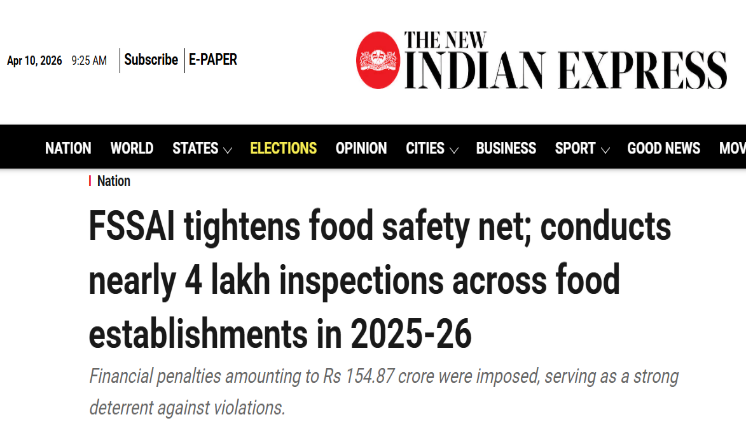
Recently, according to official sources, the Food Safety and Standards Authority of India (FSSAI) has conducted nearly 4 lakh inspections across food establishments in 2025–26.
The Food Safety and Standards Authority of India (FSSAI) was established under the Food Safety and Standards Act, 2006.
- Mandate:
FSSAI is responsible for setting food standards, regulating the manufacture, storage, distribution, sale, and import of food, and ensuring the availability of safe and quality food for human consumption.
- Nodal Ministry: Ministry of Health and Family Welfare, Government of India
Key Functions of FSSAI
- Standards Development:
It formulates standards for various food products to ensure they are safe for consumption.
- Food Safety Management Systems:
It provides guidelines to businesses for implementing effective food safety management practices.
- Licensing and Registration:
It issues licenses to food businesses and ensures compliance with food safety regulations.
- Surveillance and Monitoring:
Regular inspections and audits are conducted to check compliance with food safety standards.
- Consumer Awareness:
It undertakes various initiatives to educate the public about food safety, hygiene, and nutrition.
Accreditation:
It is also responsible for accrediting food testing laboratories across India.
Topic Related Videos ⬇️

Arogya Van Initiative
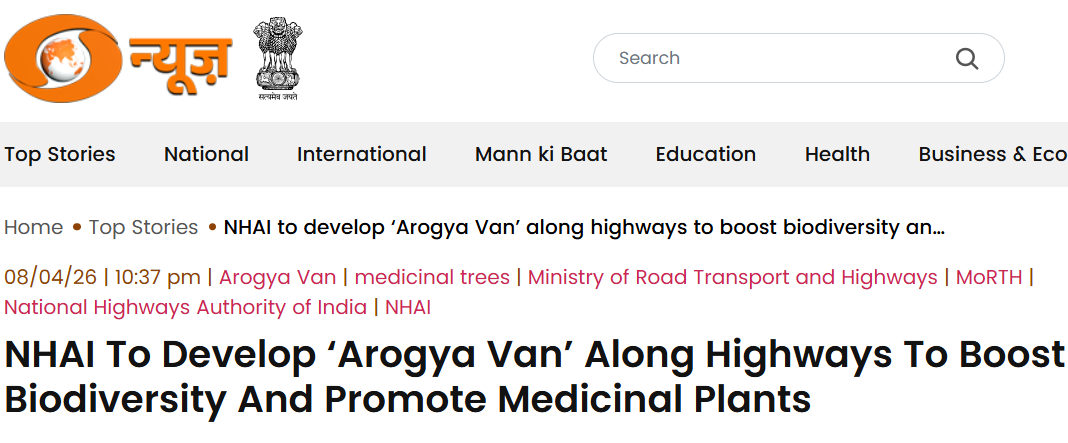
The National Highways Authority of India (NHAI) has launched the ‘Arogya Van’ initiative to enhance biodiversity and promote medicinal plants along highways. In the first phase, more than 67,462 medicinal trees (such as neem, amla, jamun, etc.) are being planted over 62.8 hectares of land across 11 states.
Latest Details of the Arogya Van Initiative
- Objective:
To transform vacant land along National Highways into green medicinal corridors and strengthen the ecosystem.
- States Covered:
The project is being implemented in Madhya Pradesh, Haryana, Delhi-NCR, Andhra Pradesh, Gujarat, Karnataka, Odisha, Tamil Nadu, Rajasthan, Maharashtra, and Chhattisgarh.
- Plantation:
Over 36 types of medicinal trees—such as neem, amla, tamarind, jamun, lemon, gular, and maulsari—will be planted at 17 identified locations.
- Timeline:
These trees are planned to be planted during the upcoming monsoon season.
- Significance:
This initiative will not only improve the environment but also increase public awareness about medicinal plants, especially around toll plazas and roadside areas.
Nodal Ministry
- Ministry of Road Transport & Highways
Topic Related Videos ⬇️
National Quantum Mission
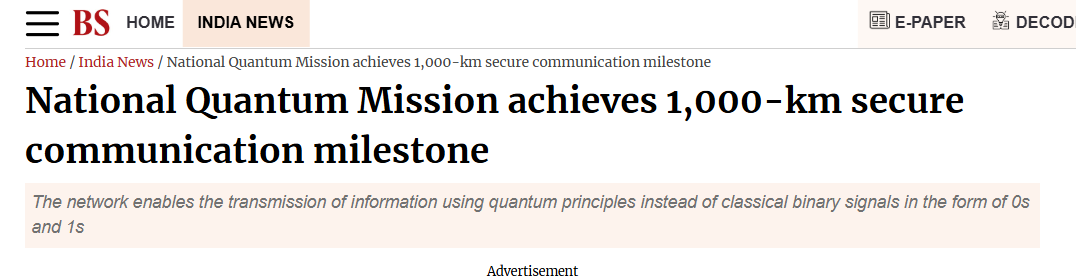
The Union Minister stated that India has successfully demonstrated a 1,000-kilometre-long quantum communication network under the National Quantum Mission, marking a major breakthrough in secure communication technologies.
The National Quantum Mission (2023–2031) is a flagship initiative launched by the Department of Science & Technology (DST) with a budget outlay of ₹6,003.65 crore. Its objective is to make India a global leader in quantum computing, communication, sensing, and advanced materials. The mission focuses on developing a 1000-qubit quantum computer over a period of 8 years.
Key Highlights
- Duration and Budget:
2023–24 to 2030–31 (8 years), with a total outlay of ₹6,003.65 crore.
- Targets:
To develop intermediate-scale quantum computers with 50–100 physical qubits in 5 years and 500–1000 physical qubits in 8 years.
- Focus Areas:
The mission focuses on four key domains: quantum computing, quantum communication, quantum sensing, and quantum materials.
- Secure Communication:
Development of satellite-based secure communication over distances exceeding 2000 km and inter-city quantum key distribution (QKD).
- Global Position:
India has become the 7th country to have a dedicated quantum mission, after countries like the United States, China, and Finland.
- Applications:
Expected to bring transformative changes in sectors such as healthcare, defence, digital security, and climate change.
- It is one of the nine key initiatives under the Prime Minister’s Science, Technology and Innovation Advisory Council (PMSTIAC).
Implementation Strategy
- The mission is being implemented by establishing four Thematic Hubs (T-Hubs) in leading institutions across India.
- Each hub will follow the Hub-Spoke-Spike model.
Four Key Areas of the Mission
1. Quantum Computing
- Lead Institution: Indian Institute of Science (IISc), Bengaluru
2. Quantum Communication
- Lead Institution: Indian Institute of Technology (IIT), Madras
- Partner: Centre for Development of Telematics (C-DOT), New Delhi
3. Quantum Sensing & Metrology
- Lead Institution: Indian Institute of Technology (IIT), Bombay
4. Quantum Materials & Devices
- Coordinating Institution: Indian Institute of Technology (IIT), Delhi
This mission promotes academic and industrial research to build a strong ecosystem in quantum technology and develop a skilled workforce in the field.
Topic Related Videos ⬇️