Production Linked Incentive Scheme for Food Processing Industry (PLISFPI)
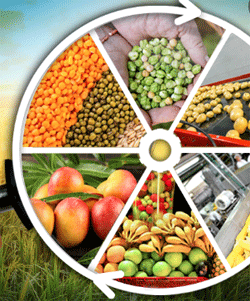
The Production Linked Incentive Scheme for Food Processing Industry (PLISFPI) has shown encouraging results. Under this scheme, total investments have exceeded ₹9,000 crore, while the committed investment was around ₹7,000 crore.
- It was launched by the Ministry of Food Processing Industries.
- It is a major initiative aimed at strengthening India’s food processing sector, promoting Indian brands in global markets, and creating world-class food manufacturing champions.
- Its objective is to increase value addition in the food processing sector, expand processing capacity, and generate employment, especially in rural and non-agricultural areas.
Financial Outlay and Duration
- The scheme is being implemented for a total period of 6 years, from FY 2021–22 to 2026–27.
- The total financial outlay is ₹10,900 crore.
Key Components of the Scheme
- Incentives for manufacturing in four major food product segments:
- Ready-to-Cook / Ready-to-Eat (RTC/RTE) foods
- Processed fruits and vegetables
- Marine products
- Mozzarella cheese
- Promotion of innovative/organic products by Small and Medium Enterprises (SMEs).
- Support for branding and marketing in overseas markets, including:
- In-store branding
- Shelf space rental
- Marketing activities
This aims to promote strong Indian brands globally.
Objectives of the Scheme
- To ensure better prices for agricultural produce and increase farmers’ income.
- To support food manufacturing units with a minimum threshold of sales that are willing to invest in expanding processing capacity and branding abroad.
- To create globally competitive food manufacturing champions.
- To enhance the visibility and acceptance of Indian food brands in international markets.
- To increase employment opportunities in non-farm (off-farm) sectors.
Topic Related Videos ⬇️

What is the Shadow Economy?
The Shadow Economy, also known as the black market or informal/underground economy, refers to a set of economic activities that operate outside government regulations, taxation systems, or official records. It primarily involves hidden income that is deliberately concealed to evade taxes or bypass regulations.
It includes both:
- Legal but unreported activities (e.g., services without receipts), and
- Illegal activities (e.g., smuggling).
While it provides livelihood opportunities, it reduces government revenue and affects economic transparency.
Key Features of the Shadow Economy
- Outside government regulations: Businesses are neither registered nor pay taxes.
- Includes legal and illegal activities: Covers both unlawful acts (like smuggling) and legal but unreported work.
- Cash-based transactions: Mostly conducted in cash to avoid leaving a financial trail.
- Part of the unorganized sector: Often referred to as the informal or shadow economy.
Main Types of Shadow Economy
- Informal Sector: Legal activities (e.g., street vendors) conducted without registration, licensing, or formal contracts.
- Illegal Activities: Completely prohibited by law, such as drug trafficking, gambling, smuggling, and prostitution.
- Unreported Economy: Legal activities where income is deliberately not reported to evade taxes.
- Unregistered Economy: Businesses not registered with tax authorities (e.g., GST) and not complying with tax rules.
- Unrecorded Economy: Activities not captured in statistical systems, especially in rural or remote areas.
- Cash Economy: Transactions conducted in cash, making them difficult to track and a major source of tax evasion.
These activities often arise due to high tax burdens, complex regulations, and corruption.
Causes of the Shadow Economy
- High tax rates
- Complex regulatory framework
- Unemployment and poverty
- Corruption and weak governance
- Lack of awareness
- Weak legal framework
- Cash-based economic system
- High cost of compliance
Impacts of the Shadow Economy
Positive Impacts
- Employment generation (especially for unskilled workers)
- Source of livelihood for the poor
- Encourages small businesses
- Flexibility in work
- Acts as a buffer during economic crises
Negative Impacts
- Loss of government revenue
- Unfair competition
- Poor working conditions
- Lack of social security
- Economic inefficiency
- Encourages corruption
- Difficulty in economic planning
- Increases income inequality
Measures to Control the Shadow Economy
- Tax reforms: Simplified tax system and lower tax rates
- Promotion of digital payments (UPI, cards, net banking)
- Improving Ease of Doing Business
- Strict law enforcement
- Financial inclusion
- Awareness and education
- Use of technology (AI, Big Data)
Difference Between Formal and Shadow Economy
|
Basis
|
Formal Economy
|
Shadow Economy
|
|
Definition
|
Activities legally registered and monitored by the government
|
Activities not recorded or regulated by the government
|
|
Registration
|
Businesses and workers are officially registered
|
No formal registration or legal recognition
|
|
Taxation
|
Taxes are regularly paid
|
Tax evasion or avoidance
|
|
Government Control
|
Fully regulated by laws and policies
|
Operates outside government control
|
|
Transparency
|
High transparency
|
Low transparency, often hidden
|
|
Mode of Payment
|
Mostly digital and banking channels
|
Mostly cash-based
|
|
Employment Conditions
|
Job security, contracts, benefits
|
No job security or social benefits
|
|
Legal Status
|
Fully legal
|
Can be legal (unreported) or illegal
|
|
GDP Contribution
|
Included in official GDP
|
Not included in official GDP
|
|
Financial Access
|
Easy access to credit and financial services
|
Limited or no access
|
|
Working Conditions
|
Regulated and safe
|
Often unsafe and unregulated
|
|
Examples
|
Registered companies, government jobs, corporate sector
|
Street vendors, unregistered shops, illegal trade
|
Topic Related Videos ⬇️