Smog-Eating Photocatalytic Coating
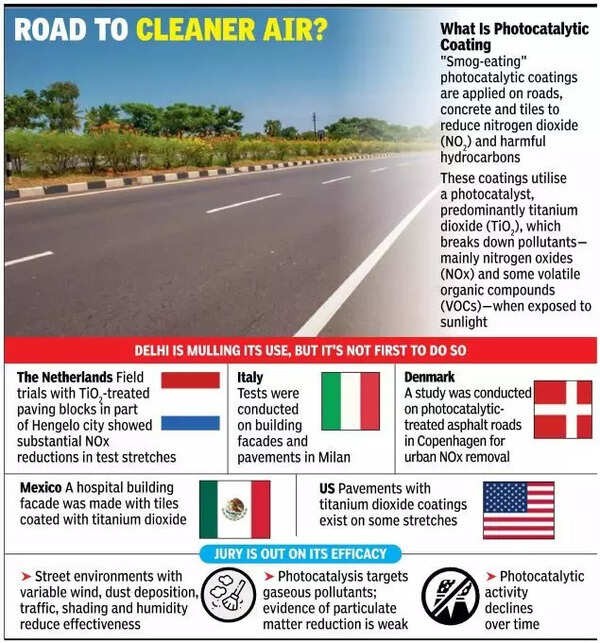
The Delhi government and IIT Madras have collaborated to design “smog-eating” photocatalytic coatings for roads.
This coating is designed to neutralize harmful gases such as:
👉 Nitrogen dioxide (NO₂)
👉 Volatile hydrocarbons
which contribute to toxic air pollution.
It generally uses titanium dioxide (TiO₂). It has been demonstrated that TiO₂-based photocatalytic construction materials are effective in controlling gaseous pollution and in environmental purification.
🔹 Key Advantages
- Low cost
- Chemically stable
- Compatible with conventional construction materials
⚙️ Working
- Photocatalytic activity uses light energy
- It breaks down harmful substances and organic waste
👉 into less toxic or harmless compounds
🌫️ What is Smog?
Smog is a type of air pollution formed by the combination of:
👉 Smoke
👉 Fog
It represents a broad category of pollutants formed through various processes depending on atmospheric conditions.
🔹 Types of Smog
1. Sulfurous Smog
- Caused by a high concentration of sulfur oxides in the air
- Mainly due to the use of sulfur-containing fossil fuels like coal
2. Photochemical Smog
- Commonly found in urban areas
- Occurs where there is a high number of vehicles
🔚 Conclusion
Smog-eating photocatalytic coating is an innovative technology that can play a significant role in reducing urban air pollution. If implemented on a large scale, it can be an effective step toward a cleaner and more sustainable environment.
Topic Related Videos ⬇️
Cabinet Committee on Security (CCS)
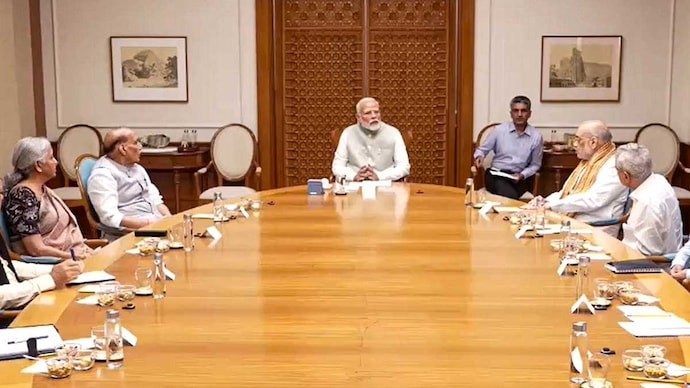
Recently, the Prime Minister of India chaired a meeting of the Cabinet Committee on Security (CCS).
In this meeting, the global situation was reviewed in the context of the ongoing conflict in West Asia, and the mitigation measures taken so far across various sectors were assessed.
The CCS is an important committee headed by the Prime Minister, responsible for making key discussions and decisions regarding defence policy, defence expenditure, and issues related to national security.
- A structure similar to the CCS was first established in independent India in 1947.
- It was formed keeping in mind the national security challenges of that time.
👉 It was chaired by the then Prime Minister Jawaharlal Nehru, with:
- Home Minister Sardar Patel
- Defence Minister Baldev Singh as members.
- After the 1999 Kargil War, the committee was given its present formal structure.
👉 It then evolved into a high-powered committee dealing with defence and national security.
- Over time, the CCS has become:
👉 The apex decision-making body of the Government of India
👉 On matters related to internal and external security
Composition
- Chairperson: Prime Minister
- Members:
- Home Minister
- Defence Minister
- Finance Minister
- External Affairs Minister
👉 The National Security Advisor (NSA) acts as a coordinator
👉 Other members may be included as per requirement
👉 The Cabinet Secretariat:
- Maintains records of CCS meetings and proceedings
Functions
The CCS deals with decisions related to:
- Defence
- Foreign Affairs
- Intelligence
- Nuclear issues
- Space policy
- Major appointments related to national security
👉 It is also the apex body for appointing senior officials in national security institutions
Conclusion
The Cabinet Committee on Security (CCS) is a central pillar of India’s national security framework. It ensures the country’s security by taking strategic decisions in response to evolving global challenges.
Topic Related Videos ⬇️