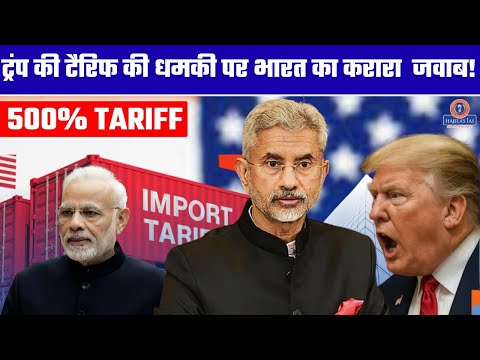
U.S. President Donald Trump has announced a 25% tariff on goods imported from India.

Along with this, he also mentioned penalties for doing trade with Russia, though the nature and type of such penalties are not yet clear.
On April 2, President Donald Trump announced the imposition of tariffs on over 100 countries, including India.
Trump stated that if any country imposes high import duties on American goods, then the U.S. will also impose higher tariffs on goods coming from that country. He termed this a "reciprocal tariff."
In April, Trump had announced a 26% tariff on India. At that time, he said India could still enter into a trade deal with the U.S.
The original tariff deadline was set for July 9 but was later extended to August 1. Just two days before this deadline, Trump announced a 25% tariff on Indian goods.
This should not be seen as just a 25% tariff because there is also a 10% penalty involved, which means the effective tariff is now 35%.
The 25% base rate plus the 10% penalty tariff will remain in effect as long as India continues to buy oil from Russia. In total, this amounts to a 35% tariff.
Although trade negotiations between India and the U.S. were ongoing, disagreements remained in certain areas.
According to reports, India was opposing the import of genetically modified crops (such as soybeans and corn) and was not willing to open its domestic dairy market to foreign companies.
Trade Between India and the United States
In 2024, trade between India and the United States amounted to $129 billion, with India having a trade surplus of approximately $46 billion.
India is among the countries that impose the highest tariffs on U.S. goods. On average, India imposes 17% tariffs on imports, while the U.S. tariff rate before April 2 was only 3.3%.
According to a report by The Indian Express, until 1990–91, India’s average tariff rate was as high as 125%. After liberalization, these rates gradually decreased. By 2024, India's average tariff rate had come down to 11.66%.
As per The Hindu, the Indian government has eliminated tariffs that were previously set at 150%, 125%, and 100%.
After Donald Trump returned as President, the Indian government made changes to tariff rates. For instance, the tariff on luxury cars in India was 125%, which has now been reduced to 70%.
As a result, by 2025, India’s average tariff rate has further decreased to 10.65%.
Although every country imposes tariffs, India is still one of the countries with the highest tariff rates globally. This is why Trump repeatedly refers to India as one of the most protectionist economies in terms of tariffs.
Trump wants to eliminate the U.S. trade deficit with countries it trades with.
Which Sectors in India Will Be Affected?
Donald Trump has announced a 25% tariff on Indian goods, but he has not provided a detailed breakdown of which sectors will face how much tariff.
However, when the tariff was first announced in April, it was clear which sectors in India would be impacted.
Products exported from India to the U.S. come primarily from 30 sectors—6 in agriculture and 24 in industrial sectors.
At that time, one of the most notable points was that India's largest industrial export— the pharmaceutical industry (worth nearly $13 billion)—was exempted from the tariff.
Whether the same exemption applies this time is still unclear.
The sectors most likely to be affected include:
- Jewelry,
- Textiles,
- Telecom and electronic goods,
- Automobiles, and
- Chemicals.
Jewelry and Gem Sector:
India exports around $11.88 billion worth of gold, silver, and diamonds to the U.S.
If exports in this sector decline, it will impact small artisans and traders, especially in states like Gujarat, Rajasthan, and Maharashtra.
Textile Industry:
India exports $4.93 billion worth of textiles to the U.S., so this sector is also expected to take a hit.
The effect on the textile industry will also depend on tariffs imposed on India’s neighboring countries.
For instance, Bangladesh exports a large volume of textiles, and Vietnam has already signed a trade deal with the U.S.
If this trend continues, the U.S. trade with India and Bangladesh could shift to Vietnam.
Since many women work in this sector, the impact on them could be significant.
Electronics:
India exports $14.39 billion worth of mobile phones, telecom, and electronic devices to the U.S., which will also be affected.
Companies like Apple, which had started operations in India, may reconsider their investments due to these tariffs.
Steel and aluminum exports from India are also expected to take a hit.
How Much Will India Lose? Where Will the Economy Go?
According to Tacno Lab Research, the tariffs could result in an annual loss of $700 million (USD 700 crore) for India.
This will directly impact the profits of Indian businesses.
The indirect impact will be on the broader economy.
The basic rule of economics is:
When exports decline, consumption falls, jobs are lost, and people who had just come out of poverty may fall back in.
A rise in tariffs directly affects production, and a decline in production leads to job losses, disrupting the entire economic cycle.
But There’s Another Side Too:
India is still engaged in bilateral trade negotiations with the U.S., so it's premature to jump to conclusions.
India currently has a trade surplus with the U.S. — meaning India exports more than it imports.
Even if a 25% tariff is imposed, it will only reduce the $45 billion trade surplus, not eliminate it.
However, sectors like automobiles and pharmaceuticals could still face significant impacts.
Reason for Trade Deal Failure:
The main reason the trade deal between India and the U.S. has not materialized is India’s unwillingness to open its markets for American agricultural and dairy products.
India imposes an average tariff of 37.7% on U.S. agricultural products, whereas the U.S. imposes only 5.3% on Indian agricultural goods. After Trump’s recent announcement, tariffs on Indian products entering the U.S. have now reached 25%.
Opening the market for agricultural and dairy products could be costly for India, as agriculture plays a crucial role in the Indian economy.
If American agricultural and dairy products enter the Indian market, it will negatively affect small Indian farmers.
Following President Trump’s announcement, India’s Ministry of Commerce and Industry issued a statement saying:
“The government gives the highest priority to the welfare and interests of Indian farmers, entrepreneurs, and Micro, Small and Medium Enterprises (MSMEs).”
What Are India's Options?
The Ministry also stated that India and the U.S. have been in talks over the past few months to finalize a fair, balanced, and mutually beneficial bilateral trade agreement, and both countries remain committed to that objective.
In response to U.S. tariffs, India’s best option currently is to push for an effective trade deal.
If the deal does not go through, India will have to look for alternative export markets or restructure the export routes for goods headed to the U.S.
If America is stepping back, India has the opportunity to explore other paths.
For instance, India recently signed a Free Trade Agreement (FTA) with the United Kingdom. Such opportunities should be taken seriously.
To offset losses from the U.S., India may also need to increase trade with Russia and China.
India already shares strong ties with Russia, but it would need to rebuild trade relations with China.
What Are India’s Options?
If India increases tariffs, the U.S. will retaliate in a similar manner.
Instead, diverting its markets could be a better strategy.
China faces over 100% tariffs, but it redirected its products toward Europe.
Now that Chinese goods are already present in European markets, India will also face stiff competition there.
India should consider diverting its products toward Middle Eastern and African markets.
However, given the strategic partnership between India and the U.S., there is a possibility that these tariffs may be reduced in the future.
India should avoid raising tariffs.
Instead, it must engage in back-channel diplomacy with President Trump.
There is a growing perception in the U.S. that China and India are progressing rapidly and must be contained.
This mindset also requires a diplomatic-level response.
Topic Related Videos ⬇️