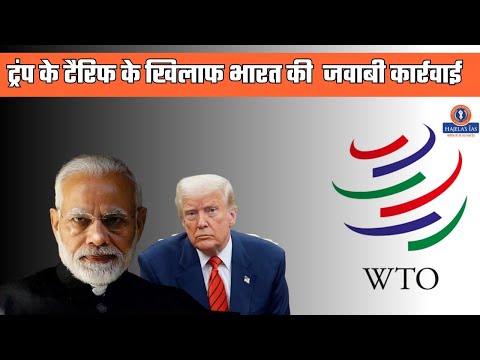
India's First Retaliatory Action Against Donald Trump's Tariffs: India Proposes Tariff Imposition on U.S. Goods at the WTO

At a time when India and the United States are engaged in talks to finalize a trade agreement, fresh tensions have surfaced. India has officially notified the World Trade Organization (WTO) of its proposal to impose tariffs on U.S. imports worth $7.6 billion.
This move is in response to the United States increasing import duties on steel and aluminum to 25%.
In March 2025, the U.S. imposed a 25% tariff on steel and aluminum imports—an extension of the tariffs initially introduced in 2018 during President Donald Trump’s first term.
This issue first became a point of contention during Trump’s initial presidency in 2018 when he imposed high tariffs on steel and aluminum imports.
Later, in February 2025, at the start of his second term, President Trump revised the measures by imposing a 25% tariff effective from March and removed all country-specific and product-specific exemptions that many countries had previously secured.
In April, the U.S. rejected India’s proposal to hold consultations on the matter, stating that these tariffs are not safeguard measures but actions taken in the interest of national security. However, India contends that these are indeed safeguard measures.
In its communication to the WTO, India stated:
“The United States has not notified the WTO about these measures, but they are fundamentally safeguard actions.”
India argued that the actions taken by the U.S. are inconsistent with the General Agreement on Tariffs and Trade 1994 (GATT 1994) and the Agreement on Safeguards (AoS).
Furthermore, India asserted that since the U.S. failed to conduct mandatory consultations under Article 12.3 of the AoS, India is entitled to undertake retaliatory action.
India added that its proposed measures would involve suspension of concessions or other obligations on select U.S.-produced products, resulting in increased tariffs on these goods.
“India reserves the right to suspend concessions or other obligations after 30 days from the date of this notification (May 9, 2025).”
The letter further stated that the U.S. measures would affect imports worth $7.6 billion from India, with projected tariff collections of $1.91 billion.
“Accordingly, similar tariffs will be levied on U.S.-produced products as a result of India’s proposed suspension of concessions,” it said.
India also mentioned that it would inform the WTO's Council for Trade in Goods and the Committee on Safeguards of its next appropriate steps.
If India proceeds with its retaliatory measures, it will not be the first time.
In June 2019, India imposed higher tariffs on 28 U.S. products after the U.S. removed India from its Generalized System of Preferences (GSP) and refused to roll back the 2018 steel and aluminum tariffs.
These duties—valued at $240 million in trade—were eventually lifted in September 2023 following Prime Minister Narendra Modi’s state visit to Washington.
India and the United States are currently attempting to finalize a trade agreement, under which India has offered to reduce its tariff disparity with the U.S. by two-thirds.
India, the world’s second-largest producer of crude steel, stated in the documents submitted to the WTO that these U.S. measures would impact Indian-made products worth $7.6 billion imported into the U.S.
Topic Related Videos ⬇️